Path-based Reasoning on Knowledge Graphs for Explainable Recommender Systems
A hands-on tutorial with hopwise at the 35th ACM International Conference on Information and Knowledge Management (CIKM '26)
Abstract
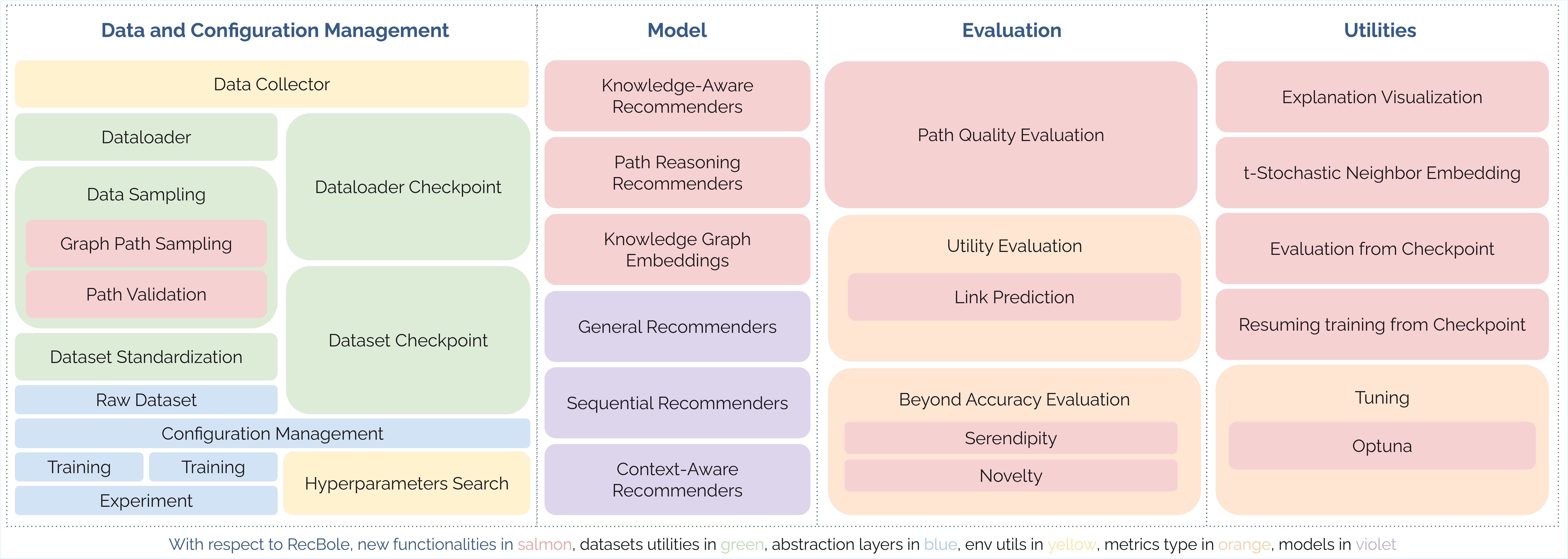
Recommender systems are central in modern knowledge-intensive applications. Beyond predicting user-item interactions, this class of systems increasingly requires models to reason over heterogeneous entities, relations, and contextual evidence while remaining transparent, trustworthy, and reusable. Path reasoning over knowledge graphs provides a principled foundation for this goal, as it connects users, items, and knowledge through semantically meaningful chains that support explainable recommendation. However, adoption remains limited by fragmented implementations, heterogeneous preprocessing pipelines, and high coding complexity. This tutorial introduces hopwise, a framework for building explainable-by-design recommender systems through path reasoning on knowledge graphs. Participants follow a progressive hands-on workflow: transforming recommendation datasets into knowledge graphs, running reinforcement learning-based and language model-based reasoning methods, evaluating their utility and explainability, and extending the framework from multiple perspectives.
What You Will Learn
By the end of the tutorial, attendees will be able to:
Relate explainability to knowledge-intensive information systems
Describe how transparent recommendation methods support inspection, trust, and accountability in retrieval, ranking, and decision-support scenarios.
Conceptualize path reasoning
Describe explainable recommendation as a knowledge graph traversal process that connects users, items, entities, and contextual evidence through interpretable reasoning paths.
Compare path reasoning paradigms
Identify key differences between reinforcement learning-based and language model-based methods for generating recommendation paths and explanations.
Run an explainable recommendation pipeline
Use hopwise for knowledge graph loading, path reasoning execution, path extraction, and explanation generation.
Assess recommendation and explanation quality
Apply the evaluation metrics integrated in hopwise and interpret their implications for recommendation utility, explanation usefulness, and evidence transparency.
Explore and customize the explainable recommendation workflow
Adapt data, configurations, reasoning strategies, or evaluation components of hopwise to new knowledge-intensive domains.
Tutorial Outline
A progressive pipeline: from foundations, to knowledge graph construction, to executable path reasoning workflows, and finally to evaluation and extension.
From Knowledge-Intensive Recommendation to Path Reasoning Workflows
90 min-
Explainable Recommendation in Knowledge-Intensive Information Systems
We introduce explainability as a core requirement for recommender systems operating in decision-support scenarios. We present the full explainable recommendation pipeline and frame knowledge graphs and path reasoning as mechanisms for connecting recommendations to evidence. We contrast post-hoc explanation approaches with explainable-by-design methods.
-
From Recommendation Data to Knowledge Graphs
We show how users, items, interactions, entities, and contextual signals are represented in recommendation datasets, and how they can be transformed into knowledge graphs that support path reasoning in hopwise. This step emphasizes the role of knowledge graphs as an explicit layer connecting data management, retrieval, reasoning, and machine learning.
-
Path Reasoning Paradigms for Explainable Recommendation
We introduce two families of path reasoning methods: reinforcement learning-based (e.g., PGPR, TPRec) and language model-based (e.g., KGGLM, PLM-Rec). We discuss their assumptions, strengths, and trade-offs.
-
Running Path Reasoning Methods in hopwise
We run one representative method for each family, compare their reasoning behavior, and visualize the generated explanation paths in hopwise. This hands-on segment shows how different reasoning strategies expose recommendation evidence.
Evaluation, Customization, and Open Directions for Explainable Recommendation
90 min-
Evaluating Recommendation Utility and Explanation Quality
We inspect the standardized path representation, translate reasoning paths into natural-language explanations, and evaluate recommendation utility and explanation path quality in hopwise. The focus is on interpreting results as both predictive performance indicators and evidence of explanation usefulness, transparency, and reliability.
-
Extension Showcase through Differentiated Exercises
We engage participants at different levels of technical depth by letting them choose one of the following guided exercises: running existing methods on another knowledge graph available in hopwise, experimenting with configuration parameters to observe changes in recommendation and explanation patterns, or coding a simple new evaluation metric perspective.
-
Open Directions in Explainable Knowledge-Aware Recommendation
We conclude with a brief discussion of current challenges, grounded in recent literature, including explanation faithfulness, scalability, robustness, evaluation limitations, and the integration of symbolic and language-based reasoning. This segment is intended to motivate participants to extend hopwise toward emerging CIKM-relevant directions.
Who Is It For
Researchers, practitioners, and doctoral students working on information retrieval, knowledge management, data mining, recommender systems, knowledge graphs, and explainable AI. Foundational notions are briefly introduced to establish a shared vocabulary.
Implementation-oriented
Participants with a stronger technical or methodological background are guided to inspect where and how path reasoning models, explanation generators, and evaluation metrics are implemented, exploring data transformation, graph construction, reasoning strategies, and evaluation procedures.
Application-oriented
Participants interested in applying explainable recommendation to knowledge-intensive domains (e.g., education, music, cultural heritage, e-commerce, or scientific information access) rely on hopwise abstractions and interact mainly through configuration parameters, without low-level coding.
Required materials
Only a web browser on a personal device with an Internet connection. All practical components are delivered through Jupyter notebooks executable remotely on Google Colaboratory: no local installation or specialized hardware needed.
Organizers
Ludovico Boratto webpage is Associate Professor at the Dept. of Mathematics and Computer Science of the University of Cagliari (Italy). His research interests focus on recommender systems and their impact on stakeholders, with over 130 papers published in top-tier conference proceedings and journals. He has delivered tutorials and invited talks at major venues, including CIKM, UMAP, RecSys, ICDE, ECIR, WSDM, ICDM, DSAA, and ECAI. He is an editorial board member of Information Processing & Management (Elsevier) and Journal of Intelligent Information Systems (Springer). He regularly serves on the program committees of leading conferences, where he has received four outstanding contribution awards. In this tutorial, he provides the core conceptual bridge, enabling participants to quickly build a solid foundation in responsible recommendation within the broader CIKM context.
Gianni Fenu webpage is Full Professor at the Dept. of Mathematics and Computer Science of the University of Cagliari (Italy). His research interests focus on responsible recommender systems, digital education, and personalization. He has authored more than 150 papers in conferences and journals, and has led several national and European projects, including ILEARNTV MIUR-UE (2014-2017, 10 M€, 6 partners) and the European Research M-Commerce and Development project. In this tutorial, he contributes the application- and impact-oriented perspective, facilitating the connection to knowledge-intensive platforms.
Mirko Marras webpage is Tenure-Track Assistant Professor at the Dept. of Mathematics and Computer Science of the University of Cagliari (Italy). His research ranges across various domains impacted by user modeling and personalization. He has co-authored more than 120 papers in top-tier conferences and journals, and given tutorials at ECML-PKDD, RecSys, ICDE, ECIR, WSDM, ICDM, and UMAP. He is part of the program committees of top-tier conferences, where he received four outstanding reviewer awards. He is an associate editor for Springer's Journal of Ambient Intelligence and Humanized Computing and Neural Processing Letters. In this tutorial, he is responsible for introducing the main operative parts conceptually (knowledge graphs, path reasoning algorithms and evaluation metrics).
Francesca Maridina Malloci webpage is Non-Tenure Track Assistant Professor at the Dept. of Mathematics and Computer Science of the University of Cagliari (Italy). Her research focuses on predictive analytics and decision-making algorithms in multi-stakeholder contexts, with particular attention to recommender systems. She has published extensively in international journals and conference proceedings. She has delivered tutorials at ECML-PKDD and co-organized workshops on related themes at ECML-PKDD, UMAP, and SIGIR. She has also delivered course-level tutorials for doctoral students on hopwise, leading the preparation of the teaching materials that form the basis of the present tutorial (most recently at Boise University, July 2025). In 2019, she was a visiting scientist at the Eurecat (Spain), collaborating with the Data Science and Big Data Analytics Unit.
Giacomo Medda webpage is Postdoctoral Researcher at the Dept. of Mathematics and Computer Science of the University of Cagliari. His research spans recommender systems, responsible artificial intelligence, graph modeling, and generative artificial intelligence. He has authored over 25 publications in leading conferences and journals. He co-edited the special issue “Knowledge Discovery from Graphs” in Springer's Data Mining and Knowledge Discovery journal and regularly serves on the program committees of UMAP, RecSys, and SIGIR. He co-organized the IRonGraphs workshop at ECIR 2024. He is a core architect and lead developer of hopwise, and directly supports participants in understanding and extending its internal components.
Alessandro Soccol webpage is a Research Associate at the Dept. of Mathematics and Computer Science of the University of Cagliari (Italy). His research focuses on explainable recommender systems, personalization, and uncertainty quantification. He has co-authored papers published in top-tier venues, such as CIKM and RecSys, and serves on the RecSys Program Committee. He is a core developer of hopwise and is responsible for key path reasoning and explainability modules, which he actively demonstrates and helps participants play with.
Cite
If you use the tutorial materials or hopwise in your research, please cite:
@inproceedings{10.1145/3799682.3839276,
  author = {Boratto, Ludovico and Fenu, Gianni and Malloci, Francesca Maridina and Marras, Mirko and Medda, Giacomo and Soccol, Alessandro},
  title = {Path-based Reasoning on Knowledge Graphs for Explainable Recommender Systems},
  year = {2026},
  isbn = {9798400725395},
  publisher = {Association for Computing Machinery},
  address = {New York, NY, USA},
  url = {https://doi.org/10.1145/3799682.3839276},
  doi = {10.1145/3799682.3839276},
  booktitle = {Proceedings of the 35th ACM International Conference on Information and Knowledge Management},
  numpages = {4},
  keywords = {personalization, explainable AI, recommender systems, knowledge graphs, reproducibility, open-source frameworks},
  location = {Rome, Italy},
  series = {CIKM '26}
}
@inproceedings{10.1145/3746252.3761641,
author = {Boratto, Ludovico and Fenu, Gianni and Marras, Mirko and Medda, Giacomo and Soccol, Alessandro},
title = {hopwise: A Python Library for Explainable Recommendation based on Path Reasoning over Knowledge Graphs},
year = {2025},
isbn = {9798400720406},
publisher = {Association for Computing Machinery},
address = {New York, NY, USA},
url = {https://doi.org/10.1145/3746252.3761641},
doi = {10.1145/3746252.3761641},
booktitle = {Proceedings of the 34th ACM International Conference on Information and Knowledge Management},
pages = {6328--6333},
numpages = {6},
keywords = {language model, path reasoning, reproducibility, transparency},
location = {Seoul, Republic of Korea},
series = {CIKM '25}
}